Editor’s note: This is the third in a series of four articles covering actual Notary errors and omissions (E&O) claims that did not go as anyone expected.
The Notary had never met the signer. The Notary never performed the notarization. The seal on the document did not even match the Notary’s real seal. Yet the Notary was still sued.
That, in short, is what happened to a Notary Public whose stolen identity was applied to a fraudulent warranty deed. The Notary was not the perpetrator. The Notary was another victim of the fraud. Yet it still took a lawsuit, a deposition, mediation, and thousands of dollars in legal fees to prove it.
In the first article in this series, about a Notary blamed for a late signer’s will, doing everything right wasn’t enough. In the second article about a revenge lawsuit against a truthful Notary, successfully defending against the covered claim wasn’t enough. Here, the surprise is different. Never performing the notarization wasn’t enough.
How the claim against the Notary started
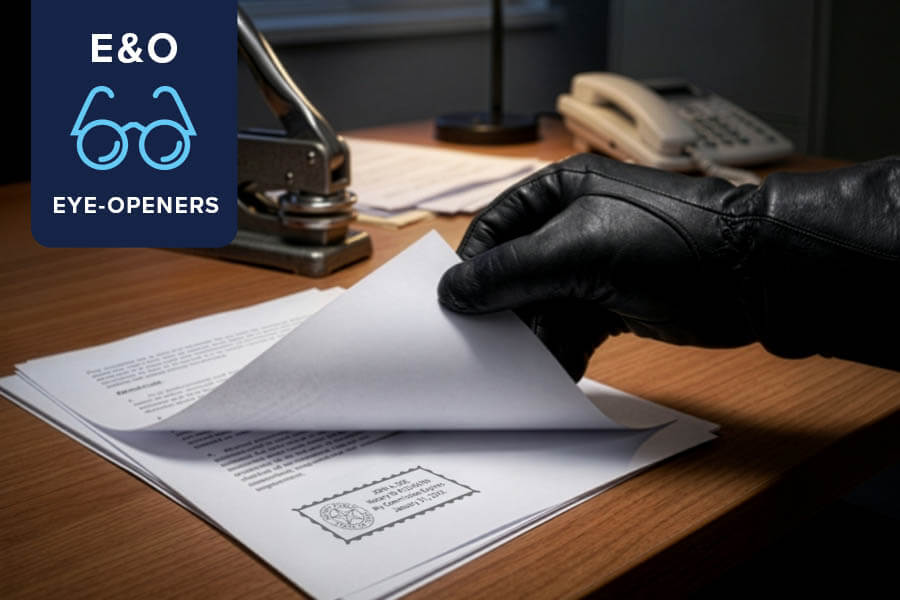
The lawsuit arose from a fraudulent warranty deed. Fraudulent warranty deeds often rely on fraudulent Notary seals. The deed appeared to contain the Notary’s seal and signature. The problem was that the Notary didn’t notarize the grantor’s signature on the document. The Notary had never met the grantor. There was no journal record of the notarization. Even the seal on the deed did not match the Notary’s actual seal.
In hindsight, it was obvious that the Notary was not involved, but the plaintiff didn’t know that and named the Notary in the lawsuit.
What the Notary did right in the case
From the beginning, the facts favored the Notary.
There was no journal record because there had been no notarization. The seal impression on the deed did not match the Notary’s seal.
The Notary learned of the fraud by being served with the lawsuit. Immediately, the Notary filed a police report.
The Notary consistently maintained that the notarization was fraudulent. During the litigation, the Notary was deposed. The testimony was credible, consistent, and supported by the available evidence. Even so, being right did not prevent the lawsuit from moving forward. The Notary still needed legal representation, still had to participate in discovery, and still had to defend against allegations arising from someone else’s fraud.
The E&O eye-opener
Most Notaries think of E&O insurance as protection against mistakes. This claim illustrates a different reality. Sometimes the Notary is not the wrongdoer. Sometimes the Notary is the victim. That is a lesson many Notaries do not expect to learn.
Ultimately, the matter was resolved at mediation. The insurer obtained a release of the Notary in exchange for a $1,000 payment. Even when the Notary is a victim, the practical reality is that obtaining a release from the lawsuit may require some contribution toward settlement. An additional $15,000 in attorneys’ fees was incurred defending the claim under a $25,000 E&O policy.
The eye-opener is not the total price tag of the lawsuit, although defending Notary seal fraud claims can be costly. The eye-opener is that without an E&O policy, the victim of the fraud could be left paying an attorney out of pocket simply to get out of the lawsuit.
The $15,000 in attorneys’ fees tells only part of the story. Those fees were incurred through counsel retained by the insurer at negotiated rates. Without E&O coverage, the Notary would have been responsible for hiring counsel independently, likely at higher prevailing rates, simply to prove the Notary was not involved and secure a release from the lawsuit.
The takeaways for Notaries
No Notary expects to be sued over a notarization that never happened. But that is exactly what occurred here. Here are several lessons every Notary can take from it.
- Protect your seal and Notary tools. A stolen or fraudulently reproduced seal can create problems long after the fraud occurs.
- Keep consistent journal records. In this case, it was not the existence, but the absence of a journal entry that was important evidence. A missing entry helped establish that the notarization never occurred. But this defense only works if you keep meticulous journal entries for all notarizations you perform.
- Report suspected fraud immediately. The Notary filed a police report as soon as the fraudulent transaction was discovered. Prompt reporting helps establish the facts, preserve evidence, and make the Notary’s story believable.
- You may need to defend yourself even when you are the victim. Sometimes, unbeknownst to a Notary, a fraudster creates a realistic counterfeit seal using the Notary’s commission information. It may take time, legal work, and money to convince a court that the Notary was not involved. An E&O policy is designed to respond to that.
- Remember that E&O insurance protects more than mistakes. One of the greatest benefits of an E&O policy is access to a defense when allegations are made against the Notary, even when the Notary did not commit the act at issue.
Bill Anderson is Vice President of Government Affairs at the National Notary Association.