Editor’s Note: The NNA presented the findings of its position paper Securing the Vote, to the Notary Public Administrators Section of the National Association of Secretaries of State this past July. The full report is available at the link above.
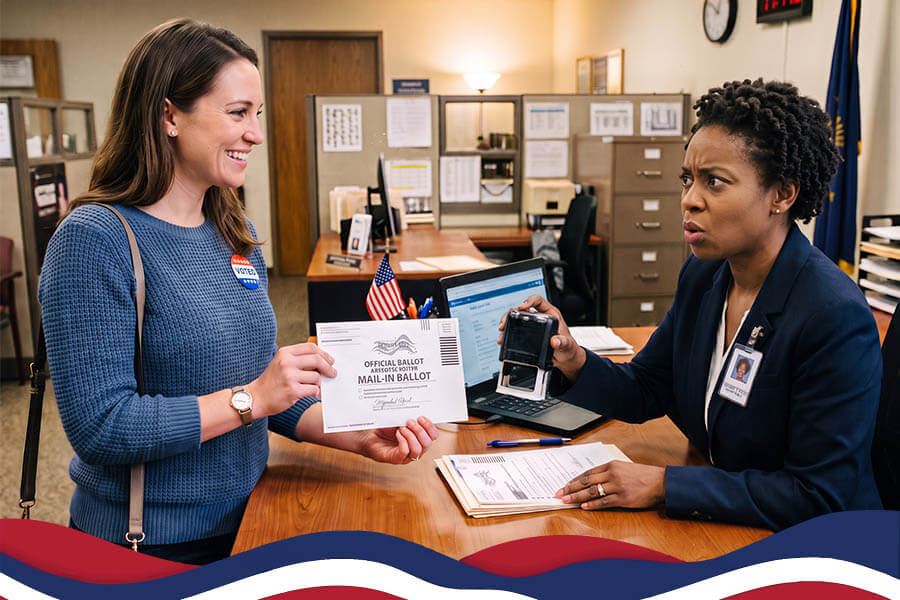
In eight states and Guam, a Notary may play a formal role in the absentee voting process. Absentee ballots are designed with election laws in mind, but don’t always address the Notary’s role in the process. This presents obstacles for many Notaries seeking to assist voters.
How Notaries are involved in absentee balloting
Absentee ballot witness requirements vary by state.
Oklahoma requires a Notary to witness the voter's signature on the absentee ballot envelope.
Mississippi and Missouri require the involvement of a Notary or other authorized official.
Alabama, Alaska, Minnesota, and North Carolina permit either one or two witnesses, or a Notary or official authorized to administer oaths. Because obtaining witnesses can be challenging, especially when traveling, individuals voting absentee will often seek out a Notary to assist them with their ballots.
There are several distinct functions a Notary may be asked to perform if called upon to assist an absentee voter. These range from common duties associated with notarial acts, such as verifying a signer’s identity, administering an oath, witnessing a signature, and completing a certificate, to functions that aren’t standard notarial duties, such as witnessing the opening and sealing of a ballot, marking a ballot, or confirming that a voter wasn’t pressured or coerced to vote a certain way.
Challenges for Notaries in absentee balloting
Though only eight states and one territory have laws involving Notaries in the absentee voting process, an absentee voter could be in any state when completing their ballot. A Notary assisting an out-of-state voter may face challenges when the absentee-ballot requirements of the voter’s home jurisdiction conflict with the notarial laws of the Notary’s commissioning jurisdiction. These challenges fall into three main categories:
1. Lack of authority to perform the act requested. Some absentee ballots require a notarial act that may be permitted in the absentee voter's state, but that is not permitted in the Notary's state.
For example, Alaska’s absentee ballot envelope requires the voter’s signature to be notarized through the notarial act of signature witnessing. Alaska Notaries have the authority to perform this act, but Notaries in many other states do not.
Some absentee ballots require Notaries to perform duties that are not notarial acts at all. For example, a Minnesota absentee-ballot witness must certify that they are at least 18 years old, that the voter showed the witness the blank ballot before voting, that the voter marked the ballot in private, and that the voter enclosed and sealed the ballot in the envelope. No other state, except Minnesota, explicitly authorizes Notaries to make these non-notarial certifications.
2. Incompatible or missing Notary certificates. In most states, when performing a notarial act, a Notary must complete and sign a certificate reciting the facts of that act. But certificates on absentee ballot envelopes frequently clash with state notarial certificate requirements. Most ballot envelopes don’t include the venue wording specifying where the notarial act took place. Others omit the certificate entirely, only providing spaces for a witness to enter their name, title, and signature.
3. Conflicts with Notary seal requirements. Some absentee ballots, such as those from Minnesota and North Carolina, require a Notary to affix their seal on the ballot envelope. This can be problematic in states that don’t require Notaries to use seals. Other states, such as Alaska and Mississippi, provide no space for a seal at all, and Minnesota provides only a square box that does not accommodate the rectangular seal impressions required in some states.
Making absentee balloting Notary-friendly
Since many absentee voters are out of state when they complete their ballots, policymakers and election officials in jurisdictions where Notaries play a role in absentee voting should take into account differences in state Notary laws when drafting ballot requirements. Policymakers in every state, in turn, should recognize that Notaries may be asked to notarize absentee ballots from out of state. While states cannot dictate a sister state’s election or notarial requirements, several policy options could address these challenges, including:
- Replacing the signature witnessing requirement on an absentee ballot with a standard jurat or verification on oath or affirmation, a notarial act authorized in every state.
- Shifting non-notarial certifications to the voter, with the Notary simply administering an oath or affirmation to the voter rather than certifying those facts directly.
- Revising ballot instructions and envelope layouts to label the seal area as only required if the Notary’s commission state requires a seal, and providing sufficient space to accommodate both rectangular and circular seals.
- Enacting a broad statutory exception authorizing Notaries to perform both notarial and non-notarial absentee ballot witnessing duties.
- Creating an exception to permit Notaries in states with strict notarial certificate-compliance rules to complete another state’s verification or jurat form for absentee ballots (in California specifically).
Helping Notaries help absentee voters
In this midterm election cycle, the urgency of addressing absentee-voting challenges cannot be overstated. Voters should not be disenfranchised by conflicting legal requirements that stand between them and the ballot box. Notaries are ready to help. The NNA will continue to work with policymakers, election officials, and Notary commissioning offices to make absentee balloting more voter- and Notary-friendly.
Brooke Merritt is the Director of Government Affairs and Policy Planning at the National Notary Association.