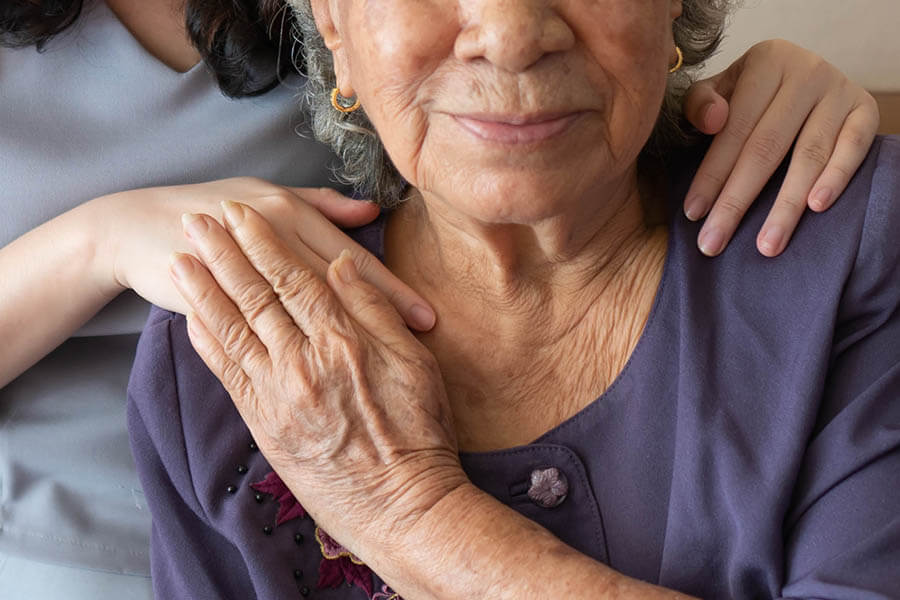
Notaries are often sought out by families navigating difficult moments. One that’s rarely discussed involves caregiving for sick or dying family members.
When I was a teenager, my grandmother was diagnosed with Alzheimer’s and dementia.
Before the diseases took over entirely, my grandmother recognized the urgency of the matter. She gave consent to my mother, who then took the necessary legal steps to set my grandmother’s situation and future in order.
A glimpse into a family caregiver’s world
I helped my mother take care of my grandmother for 15 years and experienced her final years by her side in all their colors.
But the transition to caregiving was anything but easy. As my grandmother’s increasing confusion took hold, any sense of normalcy within our family was scattered.
Repeated sentences. Irrational thoughts and behaviors. Conversations recycling into themselves for hours.
She refused to accept that her husband had passed away 30 years ago, mourning again and again through the endless denial. Family roles reversed, with my mother tending to her mother as if she were a child.
Why awareness of a signer’s situation matters
When becoming a family caregiver — sometimes referred to as an “agent” in legal documents — loved ones find themselves at the center of an entirely new world with a deluge of responsibilities orbiting around them, including complex forms that require notarization.
When the care recipient suffering from mental or physical conditions that affect their awareness needs documents notarized, it can cause great stress and difficulty for caregivers. Appointments with doctors and social workers, running errands on behalf of the care recipient while ensuring they’re as comfortable as possible, and simultaneously trying to attend to your own matters, often contribute to overwhelm and distress.
By offering patience and kindness, Notaries can give caregivers a moment of ease, dispelling some of the struggles they’re silently enduring throughout this difficult period. Take time to ensure that your notarizations are carefully performed to reduce the risk of errors that could lead to document rejection and additional difficulties for the family.
Examples of documents caregivers need to have notarized
By notarizing documents such as a durable power of attorney or end-of-life forms, Notaries can provide families in such situations with some peace of mind as they navigate this intense and difficult process.
Power of Attorney
A power of attorney is a document that grants authority for a person to act as an attorney-in-fact for another.
Once the power of attorney document has been notarized, the agent can access:
- Right of survivorship
- Real estate
- Banking
- Tax matters
- Government benefits, such as Medicare and Social Security
Advance Medical Directive
An advance medical directive enables the agent to make medical decisions on behalf of the principal once the principal is no longer able to do so.
Successfully notarizing the advance directive gives the agent the power to make medical decisions in the form of:
- Medication
- Hospitalization
- Medical orders, such as a do-not-resuscitate order
Living Trust
A living trust provides the agent with instructions on how the principal wishes their estate, including assets and property, to be handled or distributed after their death.
Some advantages of having a living trust notarized include:
- Planning taxes
- Naming beneficiaries
- Controlling and protecting how property, assets, and businesses are distributed
What’s appreciated beyond the notarization
Even though some of the documents being notarized may appear precautionary, like early estate planning, they belie an ocean of emotions to the caregiver dealing with end-of-life.
While notarizing these documents will help lighten the load in one aspect, being empathetic with the caregiver’s situation can go a long, long way.
When we set out to get my grandmother’s affairs in order, the doctors, social workers, and Notaries all empathized with us with a certain warmth. This small gesture made a world of difference for my family and my grandmother, who would always smile at them with all her heart.
The lasting impact of serving with empathy
Understanding the gravity of the documents that family caregivers must understand and sign, and how heavily they can weigh on their minds, can leave a lasting impression.
When I look back on this chapter of our lives, gratitude is the feeling that returns.
I’m grateful for the time we all spent together, for the patience we cultivated, and for the kindness and grace we received from all the professionals we met, who provided much-needed sunshine to illuminate our path forward, keeping us going until the very end.
Christian Lopez is a writer and aspiring filmmaker based in Southern California, and previously worked as a Digital Content Intern at the National Notary Association. His current roster of projects includes a historical fiction opera, a documentary honoring his grandmother, and a feature-length screenplay.