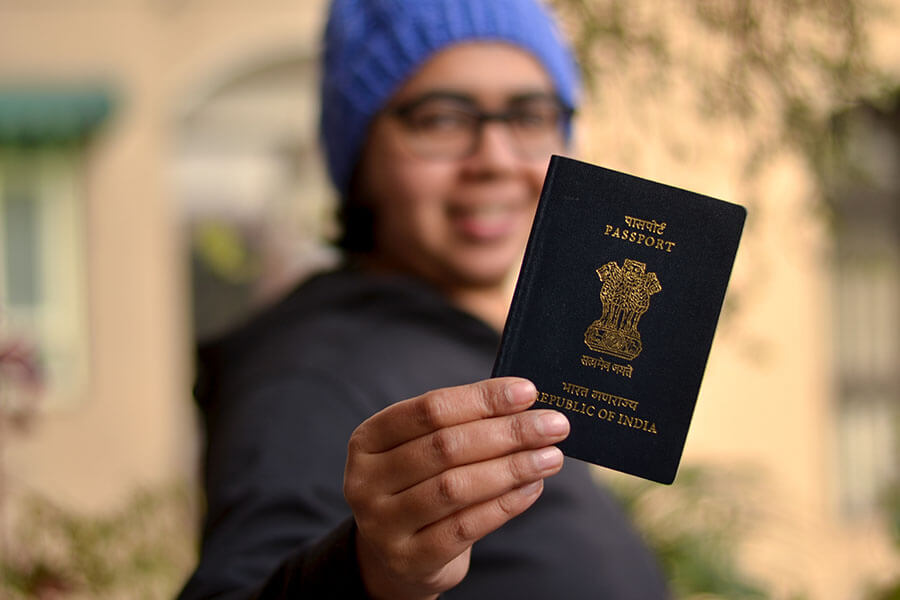
When a signer from another country requests a notarization and presents only a foreign passport or international ID, many Notaries ask:
Can I legally accept this form of identification?
The answer depends entirely on your state’s Notary laws. Some states explicitly authorize certain foreign IDs, while others impose strict conditions or limit their use to specific transactions.
Below is an overview of when you may accept foreign passports and other international IDs as proof of identification for notarization.
Foreign passports as proof of identity for notarizations
Foreign passports are the most commonly accepted form of foreign identification for notarization, but state laws vary regarding requirements.
States Requiring a USCIS Stamp
Some states require that a foreign passport be stamped by the U.S. Citizenship and Immigration Services (USCIS).
States that require a foreign passport to be stamped in order to be acceptable as ID include:
- Florida
- Georgia
- Nebraska
- Tennessee
Always verify whether additional requirements apply.
States That Allow Foreign Passports Without Specifying a USCIS Stamp
The following states allow Notaries to accept foreign passports as proof of identity, but do not explicitly require a USCIS stamp:
- Iowa
- Mississippi
- Montana
- North Dakota
- Oregon
- Utah
- West Virginia
With the exception of Mississippi and Utah, these states allow expired passports so long as the expiration date is no more than 3 years prior to the notarization.
States With Additional Foreign Passport ID Requirements
Some states impose more detailed identification standards.
California
The foreign passport must include the following:
- A serial or ID number
- Photograph
- Physical description
- Signature of the bearer
In California, a USCIS stamp is not required for Notaries to accept a foreign passport as identification, but the passport must be current or issued within the past five years
Florida
- The foreign passport must contain a serial or identifying number
- The passport must be current or issued within the past five years
Massachusetts
- The passport must contain a signature and photograph
Oregon
- A foreign passport used as ID for a notarization must be issued by a nation federally recognized by the United States
Other types of international identification for notarizations
State laws allow Notaries to accept very few other foreign IDs presented by signers.
- California allows driver’s licenses issued by Mexico and Canada that contain a serial number, photograph, physical description and signature.
- Florida also allows these driver’s licenses if the license has a serial number.
- Texas allows a current passport issued by a foreign country to be accepted as proof of identity only when the notarization is for deeds or other instruments related to a residential real estate transaction (1 TAC 87.1[1]).
In both of these states, the license does not have to be current as long as it was issued within the past five years.
Arizona and DHS-approved international IDs
In Arizona, when dealing with real estate conveyances and financing, you may accept any other valid, unexpired ID that is acceptable to the U.S. Department of Homeland Security to establish an individual’s legal presence in the United States and that is accompanied by supporting documents as required by DHS. Notaries in the state may check the Arizona Notary Public Reference Manual for more information.
Can Notaries accept consular IDs as proof of identity?
One type of ID that causes confusion is a consular ID issued by the consulate of a foreign country.
Matricula consular cards issued by Mexican consulates are among the most common of these. They look very official and reliable — especially the newer versions — but only Notaries in Illinois and Nevada are specifically allowed to accept them.
Under a 2017 law, California Notaries may accept certain foreign consular IDs if the ID:
- Is current or issued within the past five years
- Contains a serial or ID number
- Includes signature, photograph, and description
However, some Mexican matricula cards lack a physical description and therefore may not qualify.
What should Notaries do when foreign ID guidance is not provided?
Many states do not mention foreign passports or foreign IDs by name in their laws, but present a list of general requirements for any IDs that Notaries may accept.
If you are a Notary in one of these states, check your state’s Notary handbook or commissioning agency’s website for guidance.
For example, Georgia’s Notary Handbook lists a foreign passport duly stamped by the USCIS as an example of an ID that Notaries may accept from a signer as satisfactory evidence of identity.
If a signer has no acceptable identification at all, depending on the state, you may instead be able to rely on one or more credible identifying witnesses regardless of citizenship or immigration status.
In addition, for Notaries in Delaware and Virginia, a signer may present an alien registration card (U.S. Permanent Resident or “green” card) with a photograph.
Foreign IDs that Notaries should not accept
Don’t forget that foreign IDs are also often printed in a foreign language. Unless you understand the language on your client’s passport or the passport contains an English translation within it, you shouldn’t accept it, because you wouldn’t be able to verify the particulars of your client’s identity.
Of course, under no circumstances should you rely on a third party to translate information for you.


Related Articles:
Can a Notary accept an expired ID?
Additional Resources:
NNA Hotline
Notary Law Primers