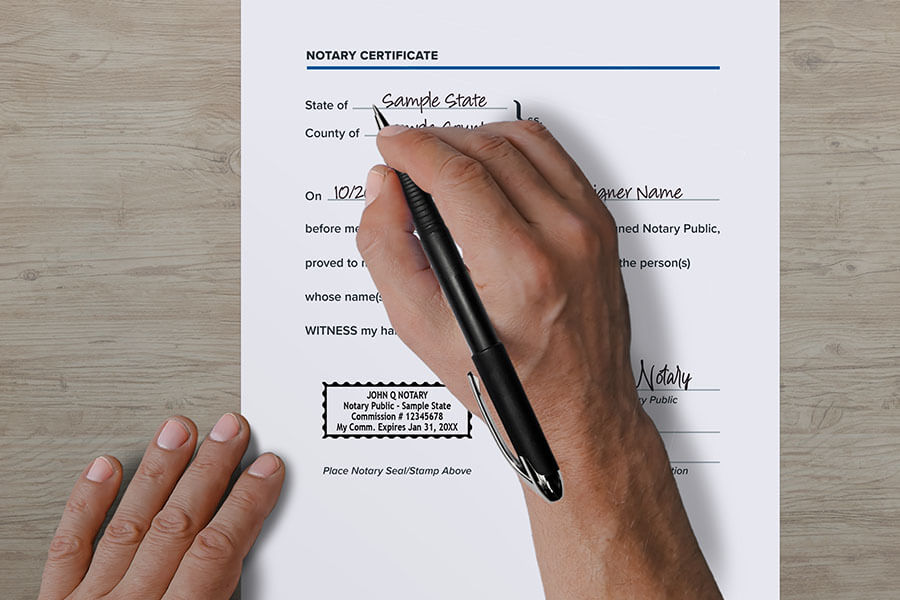
Mistakes can happen during a notarization — even for experienced Notaries. Knowing how to correct a Notary certificate properly is essential to avoid document rejection, legal issues, or violations of state Notary laws.
This guide explains when and how a Notary may correct a notarial certificate, when a new notarization is required, and best practices for preventing errors.
Tip 1: How to Catch Notary Certificate Errors Before the Signer Leaves
Catching a mistake before your signer leaves is the best-case scenario. It will minimize any inconvenience, and all the information you need to make the correction will be available.
Here are some things to keep in mind when reviewing the certificate:
- Many documents have preprinted certificate wording, such as the venue or date of the notarization, or the names of the signers. You must check to ensure the preprinted information is correct.
- Double-check all the information you have written in the certificate, such as the spelling of the signer’s name and the date, and make sure it’s correct.
- If the document requires you to enter your commission number or expiration date, double-check that all the required information is there and is correct.
- Make sure your seal has been affixed legibly.
Tip 2: Can a Notary Correct a Certificate After the Notarization Is Complete?
Fixing a mistake after the signer and document are gone is more challenging. First, you’ll need to confirm that your state allows you to correct a notarial certificate after the notarization.
In California, Notaries are not allowed to correct certificates after the notarization is finished. The only way to fix a mistake is for the Notary and signer to meet again to complete a new notarization.
In Florida, Notaries cannot correct or amend a certificate once the notarization is completed.
Even if your state allows you to fix a mistake after the notarization is complete, such as in Montana, there are other potential issues. Notaries often are asked to simply send a replacement certificate or make corrections to a faxed, photocopied or emailed copy of the original certificate. While these are the simplest, most convenient solutions, they open the door to fraud and may violate the Notary laws of your state. Make sure to check your state’s requirements to verify what you can do.
Your state, for example, may have a law that requires the certificate to be part of or attached to the document being notarized. That means anyone asking you to correct a certificate will have to send you the entire document with the original certificate. Then you’ll be able to review the document to ensure it contains your signature and cross-check your journal entry for the notarization to verify the particulars of the notarization before making the appropriate correction.
Because Notary laws vary by state, Notaries should always consult their state commissioning authority or Notary handbook before attempting to correct a certificate.
Tip 3: How to Correct a Notary Certificate Properly
When it comes to making a correction, the process is as follows:
- Line through the incorrect information.
- Print the correct information in a legible manner.
- Initial and date the correction.
- Make a notation in your journal entry.
Legibility is crucial. If a receiving agency cannot read the corrected information, they may reject the document. Also, make sure you conform to any other requirements for the document. Some state recording laws, for example, have specific requirements for margin width; any information that protrudes into the margins could cause the document to be rejected.
Never let anyone else correct a certificate you completed. The certificate is your statement about what took place with the notarization you performed. No one else may certify the facts of a notarization you performed. The notarization will be undermined if anyone else changes the information on the certificate.
Tip 4: When to Use a Replacement Notary Certificate
If the original certificate does not have enough room to properly make the corrections, you may attach a separate replacement certificate. Simply line through the original certificate, write “see attached certificate,” initial and date the original, and then complete and attach the new certificate.
If possible and if permitted by your state, use the same certificate wording that was on the original. This will reduce the chances of the document being rejected. Also, use the same date as the original.
Correcting a Notary certificate must be done carefully and in compliance with state law. By reviewing certificates before the signer leaves, understanding when corrections are permitted, and following proper correction procedures, Notaries can avoid document rejection and protect the integrity of their notarizations.


Related Articles:
When and how to use a separate (or loose) certificate
Signing Agent tip: Sending extra Notary certificates
A Notary certificate in 4 simple parts
Additional Resources:
NNA Hotline