A remote online Notary is a traditional Notary Public who meets their state's requirements to notarize electronic documents for remotely located signers.
Like Notaries who notarize paper documents for in-person signers, remote online Notaries are held to a high standard of impartiality when witnessing the signing of electronic documents for signers appearing via audio-visual technology.

Traditional Notaries vs. remote online Notaries
The table below summarizes the key differences between traditional and remote online Notaries.
| Traditional Notaries |
Remote Online Notaries |
| Signer appears in person |
Signer appears remotely |
| Paper documents |
Electronic documents |
| Physical seal stamp |
Electronic seal |
| "Wet"-ink signature |
Electronic signature |
About remote online notarization
A remote online notarization (RON) is the act of performing a notarization for a remotely located signer who appears before the Notary using two-way audio-visual technology. While state laws vary, remote online notarization generally:
- Uses electronic documents, signatures and Notary seals.
- Uses a multi-factor identification process to verify the identity of a remote document signer.
- Requires the remote online Notary to make and maintain an audio-visual recording of the remote online notarization.
- Requires the remote online Notary to use technology to make the remote notarial act tamper-evident. This is usually accomplished by the remote online Notary using a digital certificate to affix the remote online Notary’s electronic signature.
Electronic notarization vs. remote online notarization
An electronic notarization is the act of notarizing an electronic document in person. This is commonly referred to as in-person electronic notarization, or IPEN. The difference between electronic notarizations and remote online notarizations is the location of the signer at the time the notarial act is performed.
In an electronic notarization, the signer is in the Notary’s physical presence. In contrast, during a remote online notarization, the remote online Notary and signer are in two different locations.
How remote online notarizations work
Below are the steps on how to perform a remote online notarization:
- The signer personally appears before a remote online Notary in real time using audio-visual technology.
- The Notary verifies the signer's identity. In most states, the Notary must use two or more methods of identifying the signer. These may include knowledge-based authentication (KBA), credential analysis, or other forms of multi-factor identity verification.
- Once the remote online Notary verifies the signer's identity, the Notary completes the notarization by electronically signing and affixing the Notary’s electronic seal using tamper-evident technology.
- The remote online Notary collects payment and, in most states, records the notarial act in an electronic journal.
Where remote notarization is allowed
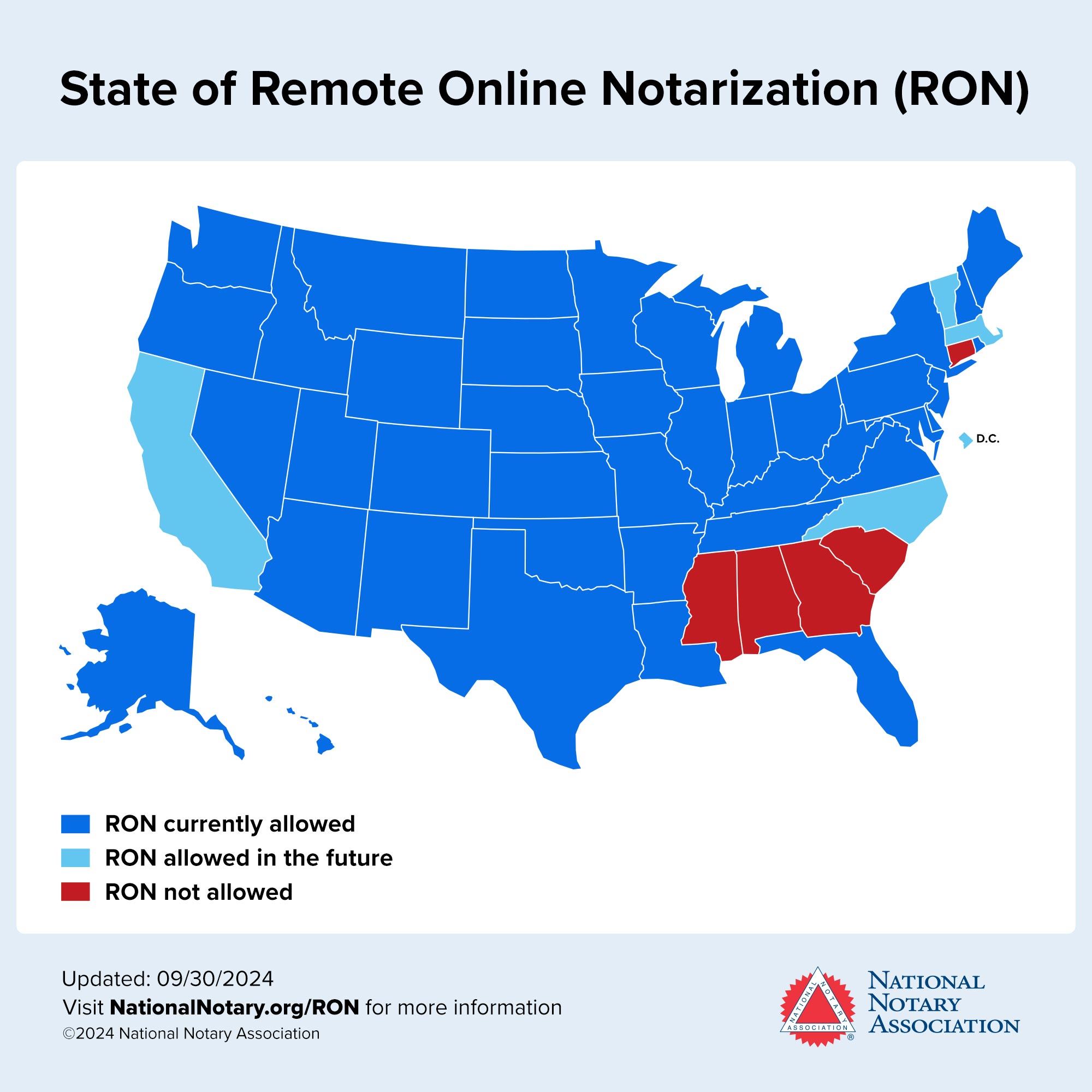
Below is the current breakdown of where Notaries are allowed to perform RON.
Notes:
- California enacted remote online notarization legislation, but Notaries cannot perform RONs until the Secretary of State certifies that it has completed the technology project necessary to implement the law, no later than January 1, 2030.
- Massachusetts Notaries may not perform remote notarization because the required training and application procedures are not yet available. The Secretary of the Commonwealth published a statement advising Notaries that they cannot provide online notarization services until after they've taken training and notified their office. We will update this information when the Secretary provides further instruction.
- Georgia, Mississippi and South Carolina have not passed laws authorizing Notaries to perform RON.
- Alabama and Connecticut have enacted remote notarization laws for paper documents only.
- North Carolina has yet to implement its Remote Electronic Notarization (REN) statute. In the meantime, North Carolina’s Emergency Video Notarization (EVN) statute is in effect until July 1, 2027, or the date the Secretary of State licenses the first Remote Electronic Notarization platform.
Benefits of being a remote online Notary
Making money, working from home and always being in demand are three of the top reasons why you should become a remote online Notary. Learn more about the benefits of online Notary work.
Remote Notary income
While fees vary by state, in states that cap RON fees, $25 is the most common maximum fee Notaries may charge for remote notarizations. Find more information on our Notary Fees By State page.
Becoming a remote online Notary
When registering as a remote online Notary, your state may require you to take a training course, sign up with a state-approved RON provider, hold a surety bond, and submit an application and fee.
If you’re interested in making more money, becoming a remote online Notary is a great step forward.