Getting a Notary Public commission requires meeting your state’s specific requirements and following the state’s application process. While the requirements vary across jurisdictions, the process generally includes these steps:
- Meet your state's qualifications.
- Complete the application form.
- Pay the state's application filing fee.
- Take training from an approved education provider (if applicable).
- Pass an exam (if applicable).
- Complete fingerprinting and a background check (if applicable).
- Receive your commission certificate from the state.
- Get a surety bond (if applicable).
- File your commission paperwork and bond with your Notary regulating official.
- Buy your Notary supplies.
State Notary Process
View step-by-step instructions to apply for a Notary Public commission in your state
In This Guide: About Commissions | Eligibility | Training & Exam | Bond & Insurance | Supplies | FAQs
About Notary Public Commissions
Before we get started, here’s what you need to know about U.S. Notary Public commissions.
Regulating official
In most states, the Secretary of State's office issues Notary commissions and regulates Notaries. In a few states, Notaries are commissioned by their county or by another state official, such as the Lieutenant Governor.
Commission term
Most Notary Public commissions are for four years though commission terms range from two years (Delaware, Vermont) to 10 years (Arkansas, South Carolina). Louisiana Notaries have lifetime commissions.
Jurisdiction
Notaries have statewide jurisdiction, meaning a Notary may perform notarial acts anywhere within their state’s borders for anyone requesting a legal notarization and who presents acceptable identification.
A few states have reciprocity agreements allowing Notaries to perform notarizations across state lines. For example, Montana Notaries may notarize in Wyoming and North Dakota.
Notary Public commission cost
The cost to become a Notary can range from less than $100 to $600 or more, depending on your state's requirements. Generally, your expenses will include:
- Application or commission fee
- Training course
- Exam fee
- Surety bond
- Notary stamp
- Notary journal
Depending on your state, additional costs may include fingerprinting, a background screening, or county filing fees. You may also need to create or purchase a fee schedule.
Commission processing time
After meeting the commissioning requirements and submitting your application, it can take between two and 10 weeks to be appointed as a Notary Public, depending on the jurisdiction.
Processing times may be longer during high-volume periods, as many Notary commissioning authorities also oversee their state’s elections and business filings.
Notary Public Eligibility Requirements
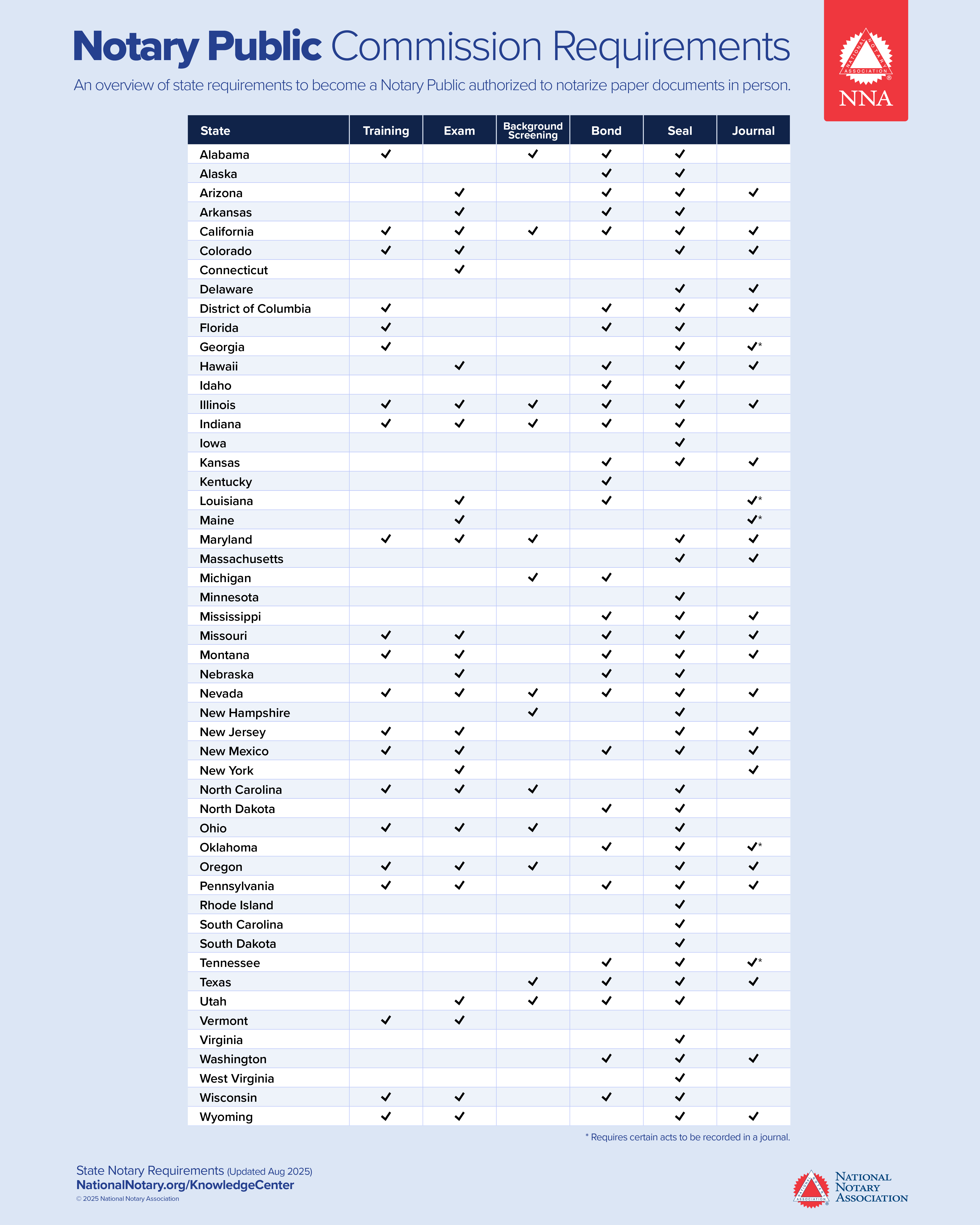
Qualifications and eligibility requirements vary from state to state. In general, you must be at least 18 years old and a legal resident of your state, be able to read and write in English, and have no disqualifying criminal offenses to receive a Notary Public commission.
Some states allow residents of neighboring states who work in the state to receive a Notary commission there.
Background checks
Notary applicants in the following states must pass a background check to obtain a commission: Alabama, California, Illinois, Indiana, Maryland, Michigan, Nevada, New Hampshire, North Carolina, Ohio, Oklahoma, Oregon, Texas and Utah.
Notary Training & Exam
Twenty-one states and the District of Columbia require applicants to complete a Notary training course. Twenty-six states require applicants to pass an exam. Though not required by law, Rhode Island advises applicants to take the state’s free training and pass a knowledge assessment before applying.
- States that require Notary training: Alabama, California, Colorado, District of Columbia, Florida, Illinois, Indiana, Maryland, Missouri, Montana, Nevada, New Jersey, New Mexico, North Carolina, Ohio, Oregon, Pennsylvania, Rhode Island*, Texas, Vermont, Wisconsin and Wyoming.
- States that require Notary applicants to pass an exam: Arizona, Arkansas, California, Colorado, Connecticut, Hawaii, Illinois, Indiana, Louisiana, Maine, Maryland, Missouri, Montana, Nebraska, Nevada, New Jersey, New Mexico, New York, North Carolina, Ohio, Oregon, Pennsylvania, Rhode Island*, Texas, Utah, Vermont, Wisconsin and Wyoming.
Required training courses typically run from three to six hours and Notary exams last roughly an hour.
Notary Bond & Insurance
A Notary surety bond protects the public against losses due to a Notary’s misconduct or negligence while a Notary errors & omissions (E&O) policy protects the Notary by covering legal defense costs and damages arising from notarial acts, including if the Notary’s commission information is stolen and used fraudulently.
Notaries in 28 states and the District of Columbia are required to secure a surety bond. The bond amount typically ranges between $5,000 to $10,000 though it can be as low as $500 or as high as $50,000, depending on the state.
Currently, no state requires traditional Notaries to carry E&O insurance, but it’s strongly recommended. Florida requires Online Notaries to carry E&O insurance.
Notary Supplies
The Notary seal is the most recognized tool of the trade, but there are other Notary supplies that may either be required in your state or recommended as a best practice.
- Seal: Most states require a Notary to use an official seal of office when notarizing documents. Depending on state law, a seal may be either a Notary stamp or embosser. A Notary stamp leaves a wet-ink impression on notarial certificates while a Notary’s embosser leaves a raised impression that may be inked to be photographically reproducible.
- Journal: Required in 27 states plus the District of Columbia, a paper journal is the best protection against lawsuits—even if your state doesn’t require it. The signer’s name, the type of notarization, and the form of ID used to identify the signer are a few details typically recorded in Notary journals.
- Certificate: A notarial certificate is specific wording that a Notary must complete and attach to the notarized document. There are several different types of notarization, each requiring a unique notarial certificate.
*Twenty-seven states require a journal for in-person paper notarizations—five of which require journal entries only for certain documents.
This Notary supply checklist includes the 10 must-have items for new Notaries.
Notary Public Commission FAQs
Why is the Notary process different in every state?
Notaries are commissioned and regulated at the state level with each jurisdiction setting its own processes and requirements.
Find your state’s Notary laws.
How can I become an electronic or remote online Notary?
Back to Top
Last updated: May 28, 2026